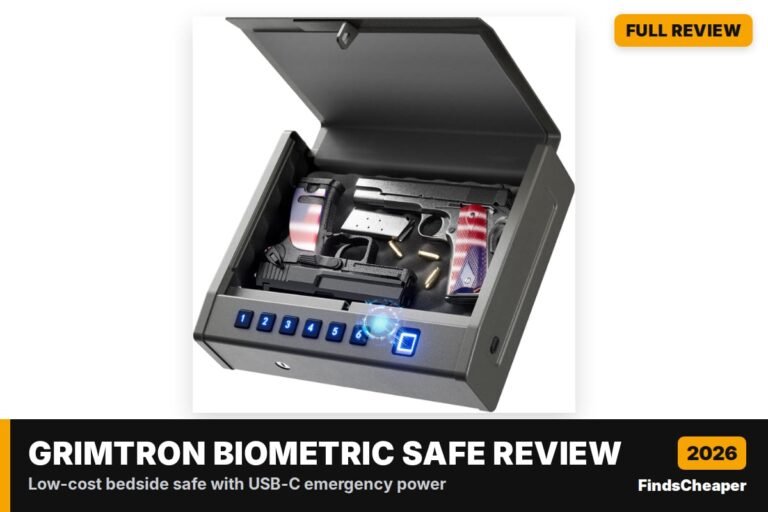
Biometric vs Keypad Gun Safe: Which Lock Is Right for You?

Short answer to the biometric vs keypad gun safe question: a keypad is the more predictable everyday lock, while a fingerprint reader is faster only when it reads your finger cleanly on the first try. For most people the best choice is a safe that offers both, plus a mechanical key backup, so a dry fingertip, a dead battery or a forgotten code never leaves you locked out. If you want no electronics at all, a mechanical push-button lock is the most power-independent option.
Below we break down how each lock type works, where each one tends to fail, how RFID and mechanical locks fit in, and how a gun safe compares with cabinets, lockers, cases, lock boxes and trigger locks. This is based on product listings, manuals and widely shared safe-storage practice, not on any claim that we put these units through a lab.
How each lock type works
Keypad (electronic code)
A keypad safe opens when you enter a numeric code. The electronics run on batteries or AC power, and a solenoid or motor releases the latch. The strengths are consistency and easy sharing: every authorized adult can learn the same code, and the safe does not care whether your hands are wet, cold or gloved. The weak points are code memory under stress, worn keys that hint at your digits, and power. Good keypads include a lockout after repeated wrong entries and a backup such as a key or external power port.
Biometric (fingerprint)
A fingerprint safe stores templates of enrolled fingers and compares each touch against them. When it works it is the fastest way in: one press and the lid opens, with no code to recall in the dark. The catch is that reliability depends on the sensor and on you. Dry winter skin, sweat, cuts, calluses and dirty sensors are common reasons for misreads, and enrolling the same finger several times at different angles usually helps. Our guide on whether biometric gun safes are reliable goes deeper on sensor quality and enrollment habits.
The bigger issue is that a weak reader can also accept the wrong finger. Awesafe, Bulldog (biometric models), Machir and MouTec biometric gun safes were recalled because the fingerprint reader could let unauthorized users, including children, open them, according to CPSC and Health Canada notices. We do not recommend those brands. See our biometric gun safe recall guide for what to do if you own one, and confirm model details on cpsc.gov.
RFID (tag, card or wristband)
RFID safes open when a programmed tag is held near the reader. Access is touch-free and fast, and tags do not suffer from dry skin or forgotten codes. The trade-offs are that the tag itself becomes the key, so it has to be kept as carefully as a house key, and that the reader still needs power. Most RFID safes add a keypad and a mechanical key as backups. If this style appeals to you, our best RFID gun safes list compares the options.
Mechanical push-button
A mechanical push-button lock, such as the Simplex-style locks found on some pistol boxes, uses a sequence of buttons to release the latch with no batteries or circuit board. That removes the most common electronic failure points. The downsides are slower entry than a fingerprint or RFID tap, fewer possible combinations than a long electronic code on some designs, and a code that is usually changed with a tool rather than a menu. For anyone who keeps a safe in a garage, cabin or vehicle that sits unused for months, the independence from batteries is a real advantage.
Biometric vs keypad vs RFID vs mechanical: side-by-side
| Factor | Fingerprint | Keypad | RFID | Mechanical push-button |
|---|---|---|---|---|
| Typical speed | Fastest when the read is clean | Moderate; depends on code length | Very fast, touch-free | Moderate |
| Needs power | Yes | Yes | Yes | No |
| Common failure points | Dry, wet or injured fingers; dirty sensor; weak readers | Forgotten code under stress; dead battery | Lost or misplaced tag; dead battery | Forgotten sequence; worn buttons over time |
| Sharing with another adult | Enroll their finger | Share the code | Program a second tag | Share the sequence |
| Backup to look for | Keypad plus key | Key or external power port | Keypad plus key | Often a key override; check listing |
| Example on this page | Vaultek LifePod 20 Biometric | Vaultek LifePod 20 | Hornady RAPiD Safe Night Guard | Fort Knox PB1 Pistol Box |
Fingerprint vs keypad safe: which should you choose?
Think about the moment you would actually open the safe. If it is a bedside or quick-access safe that you may reach for in the dark, speed matters, and a fingerprint or RFID reader saves you from finding and pressing keys. If several adults share the safe, or someone in the household has fingerprints that read poorly, a keypad is simpler and more predictable. Many buyers end up with a dual-entry model that offers fingerprint and keypad together, which is why so many picks in our quick access gun safe guide combine them.
A useful comparison is the Vaultek LifePod 20 in its two versions. The standard model opens with a touch-sensitive backlit keypad or backup manual keys, and the listing describes an optional anti-picking feature for the front keyway. It sat in the $100 to $200 range at the time of writing; check the current price on Amazon.
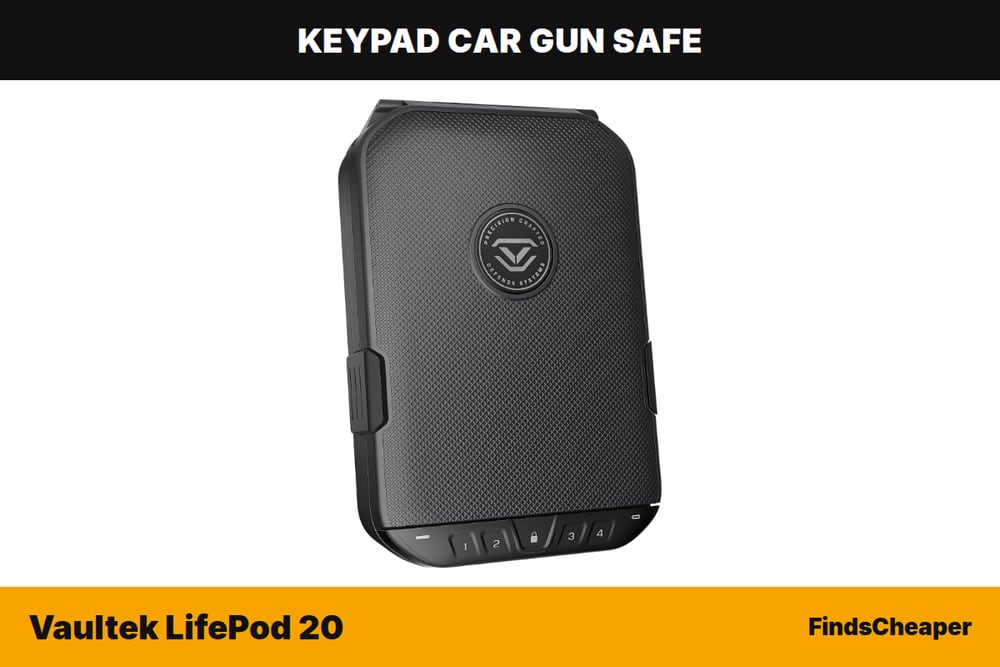
The Vaultek LifePod 20 review covers the full detail. In short, it is a non-metal polymer case with side compression latches and a rubber gasket, sized for a full-size handgun up to 9.25 inches long, with a removable interior tray. It runs on a 9V battery that the listing says lasts up to a year under normal use, and a hidden micro-USB port can power it if the battery dies. The listing quotes two different interior measurements in different places, so confirm the dimensions that matter to you before buying.
The biometric version adds a water-resistant fingerprint scanner on top of the same keypad and key backup, and it sat in the $200 to $300 range at the time of writing. That price gap is essentially what you pay for the fingerprint option on the same case.
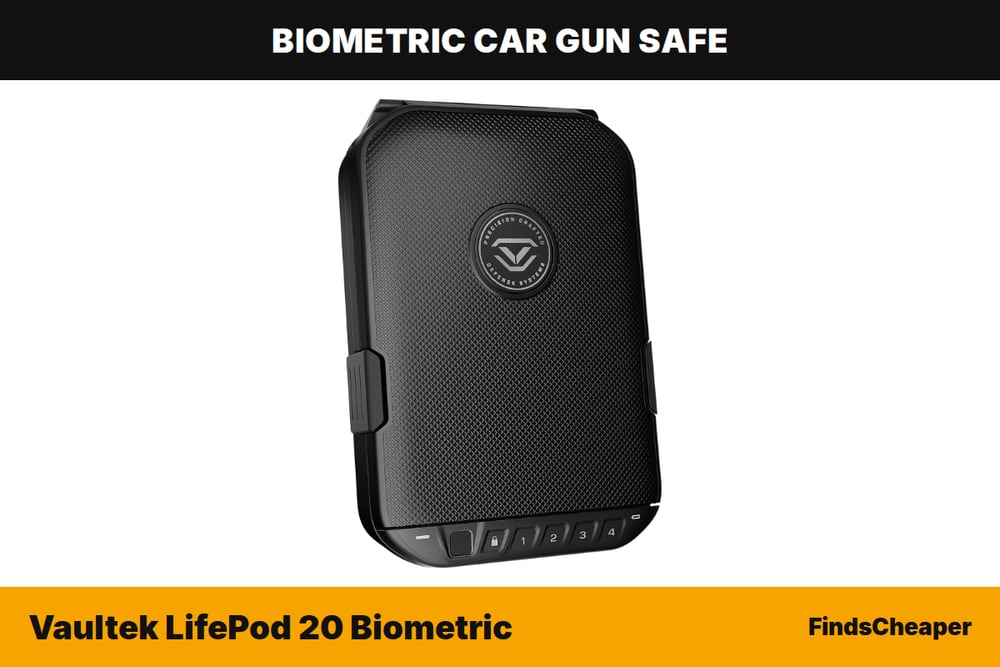
If you like the idea of fingerprint speed but want a fallback for cold mornings or gloved hands, this layout is the sensible one: scanner first, keypad second, key third. Our LifePod 20 Biometric review walks through the setup and backups, and you can check today’s price on the biometric LifePod 20.
RFID vs biometric gun safe
RFID and fingerprint safes both aim at the same goal: opening quickly without entering a code. RFID removes the skin-condition variable entirely, so it tends to be more repeatable, but you must keep the tag secure and within reach. A wristband worn at night or a tag on a keychain works well for some people and poorly for others.
The Hornady RAPiD Safe Night Guard is a good example of the RFID approach in a nightstand form. According to the listing, it is a 14 gauge steel drawer-style safe with a tempered glass front that shows the RFID reader, a clock and an access code keypad, plus circular barrel keys, a security cable, AC power with battery backup and USB-A charging ports. The included RFID wristband and key fob can be programmed to open it. Read our Hornady RAPiD Safe Night Guard review for the details, and our nightstand gun safe picks for similar bedside options.
Mechanical vs electronic gun safe
Electronic locks win on speed and convenience. Mechanical locks win on independence: nothing to charge, no circuit to fail in humidity or temperature swings, and no worry about a safe that has been sitting untouched for a season. If you can only open your safe by electronics, a key backup and a regular battery routine are not optional extras.
The Fort Knox PB1 Pistol Box is a well-known mechanical option. The listing describes a 10 gauge steel body, a 3/16 inch tamper-resistant wraparound door, a gas-strut-assisted door and a fast-opening Simplex push-button mechanical lock. It is listed as California DOJ certified and made in the USA, and it sat in the $200 to $300 range at the time of writing.
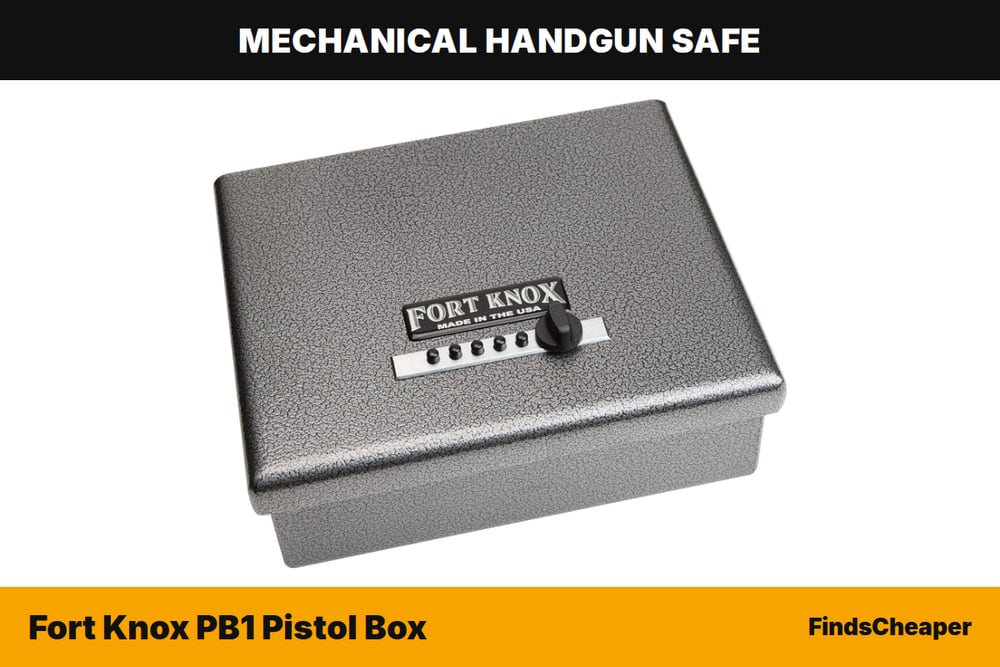
At 22 pounds and about 12.5 by 10.38 by 4.25 inches, it is heavier and bulkier than a polymer case, which is the price of all that steel. Our Fort Knox PB1 review covers fit and placement, and you can see the current Fort Knox PB1 listing.
Power, batteries and backups checklist
- Battery type: note whether it uses 9V, AA or a rechargeable pack, and set a calendar reminder to replace or recharge.
- Low-battery warning: check the manual for how the safe signals a weak battery.
- External power: a USB or barrel port that powers the lock from outside can rescue you when the battery dies.
- Key override: store the backup key away from the safe, not taped to it or in the same drawer.
- Lockout behavior: learn how long the safe locks after repeated wrong entries before you need it.
- Practice: open the safe by every method, including the backup key, so none of them is a surprise.
Gun safe vs cabinet, locker, case and other storage
Gun safe vs gun cabinet, locker or security cabinet
Gun cabinets, lockers and security cabinets are generally lighter-gauge steel enclosures designed to keep firearms away from children and casual access. A safe usually adds thicker steel, a stronger door and bolt work, and sometimes fire protection. If your main goal is keeping curious hands out and budget or floor weight is tight, a cabinet can make sense; compare options in our best gun cabinets guide. For theft resistance, a heavier safe that is bolted down is the stronger choice.
Gun safe vs regular safe or home safe
A regular home safe is built for documents and valuables, so its interior shelves are rarely laid out for long guns or handguns. A gun safe has racks, door panels or padded drawers shaped around firearms. Some people use both: a gun safe for firearms and a smaller document safe elsewhere. Check fire rating claims on the listing rather than assuming either type has one.
Gun safe vs lock box, gun case, locked case or Pelican case
Lock boxes and lockable cases are portable. They are ideal for travel and vehicles and often come with a steel security cable, like the LifePod 20. Hard cases such as Pelican-style cases protect against impact and weather, and become locked storage once you add a lock, but a case is easier to carry off than a safe. Our portable gun safe guide and car gun safe guide focus on these.
Gun safe vs trigger lock
A trigger or cable lock blocks a single firearm from being fired, but it does not stop someone from taking it. A safe controls access to the whole firearm. Many owners use both, especially when transporting a firearm in a locked case.
Comparing safe brands
Searches like Cannon vs Sports Afield, Sports Afield vs Liberty, or Field and Stream vs Winchester are really about large long-gun safes. Rather than relying on brand reputation, compare the same points on every listing: steel thickness, door construction, lock type and backup, stated fire rating and its test conditions, interior layout, bolt-down hardware and the warranty terms the brand actually publishes. Our gun safe brands overview and the main best gun safes guide are good next stops.
How to decide in five questions
- How fast do you need to open it? Bedside and quick-access use favors fingerprint or RFID with a keypad backup.
- Who else needs access? Several adults usually means keypad or multiple tags is simpler.
- Where will it live? Vehicles and garages with temperature swings favor mechanical locks or strong backups.
- What has to fit? Measure your handgun and accessories and compare against interior dimensions; see what size gun safe you need.
- Can you anchor it? A safe or lockbox should be bolted down or cabled; our bolt-down guide covers the basics.
Storage and child-access laws vary by state; check yours. Whichever lock you choose, the goal is the same: the right people get in quickly, and nobody else gets in at all. For a broader shortlist of compact options, see our handgun safe recommendations and the best biometric gun safes list.
Biometric vs Keypad Gun Safe FAQ
Is a biometric or keypad gun safe better?
Neither is better for everyone. A keypad is more consistent because it does not depend on the condition of your fingers, while a good fingerprint reader is faster when it reads cleanly. Many people choose a safe with both, plus a key backup, so they get speed most of the time and a reliable fallback when the scanner misreads or the battery runs low.
Are fingerprint gun safes safe to use with kids in the house?
A well-made fingerprint safe can be, but reader quality matters. Several biometric brands, including Awesafe, Bulldog biometric models, Machir and MouTec, were recalled because their readers could let unauthorized users, including children, open them. Avoid those brands, enroll only adult fingers, test that unenrolled fingers are rejected, and keep backup keys out of reach.
What is the difference between an RFID and a biometric gun safe?
An RFID safe opens when a programmed tag, card or wristband is held near the reader, so it is touch-free and unaffected by dry or wet skin. A biometric safe reads your fingerprint, so there is nothing extra to carry. The trade-off is that an RFID tag must be guarded like a key, while fingerprint reliability depends on the sensor and your skin.
Are mechanical gun safes more reliable than electronic ones?
Mechanical push-button locks remove batteries and circuit boards from the equation, which makes them a strong choice for safes that sit unused for long periods or live in vehicles and garages. Electronic locks are usually faster and easier to reprogram. If you choose electronic, make sure there is a key override or external power port and keep fresh batteries on hand.
What is the difference between a gun safe and a gun cabinet?
A gun cabinet or security cabinet is generally a lighter steel enclosure meant to keep firearms away from children and casual access. A gun safe typically uses thicker steel, a stronger door and more robust bolt work, and some models add fire protection. Cabinets cost and weigh less, while safes resist theft better, especially when bolted down.
Is a lock box or locked case as good as a gun safe?
Lock boxes and locked cases are designed for portability, travel and vehicles. They keep firearms away from unauthorized hands and many include a steel cable for anchoring, but they are easier to carry away than a heavy bolted safe. Use a case for transport and a vehicle, and a safe for long-term storage at home where possible.
FindsCheaper is reader-supported: as an Amazon Associate we earn from qualifying purchases, at no extra cost to you. We research listings, manuals and owner feedback; we do not accept payment for placement. Prices, coupons and availability change, so check Amazon for the current details. Store firearms safely and follow your state’s storage laws.